Peter Brötzmann’s Long Story Short (Music Unlimited Festival), Wels, Austria, 5-6 November 2011: Day 3

Peter Brötzmann has been on tour even more than usual in 2011, this being the year in which he celebrates his 70th birthday. But where did he choose to have the main event, the one that brought together pretty much all of his musical friends and collaborators, the Brötzfest to end all Brötzfests? Not Germany, not Japan and certainly not the UK, but Austria of course. Two years in the planning, Long Story Short was also the 25th Music Unlimited festival, an annual event rivalled only by the Konfrontationen festival in (this is getting embarrassing) Austria in its ability to attract, year after year, the world’s leading names in free jazz and improvised music. I was only able to make two of the festival’s four days, but the riches presented on those days were more than enough to convince one of the epochal, never-to-be-repeated nature of the event. As, indeed, was the staggering fact that the festival was sold out weeks in advance; how often has that happened at a free jazz fest?

Having said all that, I could probably have done without the extended set by Keiji Haino which opened the third full evening of the festival (I unfortunately missed what must have been a corking clash between Mats Gustafsson, dieb13 and Martin Siewert in the afternoon). Haino’s schtick is beginning to grate on me, a feeling planted by the lengthy vocal improv with which he kicked off and confirmed by the even longer instrumental passages which followed. The anguished cries, moans and utterances were those of a man being sick, while the pieces for guitar and analogue devices were intermittently entertaining but dragged on long after the point had been made. Ultimately, I would be more inclined to look favourably upon Haino’s performance if his persona weren’t so wilfully enigmatic and impenetrable, a pose that set him apart from just about every other artist at the festival.

It was something of a relief, therefore, when Peter Brötzmann took the stage for what turned out to be one of the grooviest, most sheerly enjoyable sets I’ve ever heard him play. This was due in no small part to his three co-musicians, all of whom were new to me: bassist Bill Laswell (yes, the man who ruined the sound of Swans on The Burning World), drummer Hamid Drake and guembri player Mokhtar Gania. You could tell this set was going to be unusual right from the moment Brötzmann hauled the bass saxophone onstage, a beast I’ve never heard him play before. Kicking off in duo format with Laswell’s undulant bass lines cascading around the thick resonances of the sax, the pair were shortly joined by Drake, who made an immediate impression with the deep rolling thunder of his percussion. As Brötzmann switched to tenor the exotically voiced Gania entered, and slipped with the rest of the troupe into an extended, irresistible groove. This extraordinary meeting brought into sharp relief one of the most remarkable things about Brötzmann’s recent work: the fact that he is not only a European, not only a member of the Chicago axis, but also, and increasingly, an internationalist.

From a completely new configuration to one of Brötzmann’s regular gigs, the Hairy Bones quartet with Massimo Pupillo, Toshinori Kondo and Paal Nilssen-Love. I’ve said all I have to say about this scorching line-up in previous reviews, so let me just note that this was Peter’s third full show of the day (a feat he was to repeat the following day), that the Alter Schlachthof remained packed even though the group didn’t come onstage until 12.30am, and that Brötzmann was, unusually for him, moved to complain about the onstage sound. It sounded fine to me in row 3, but who’s to say what he was or was not able to hear through his monitors. Isn’t that the sort of thing that’s supposed to be sorted out at soundcheck, though?

(Review of day 4 here.)

Death in June, Vienna Ottakringer Brauerei, 27 October 2011

Another in an occasional series in which concerts I’ve been to are used as a pretext to recall formative experiences with the artist in question. This is not a live review but a reminiscence, an extract from an autobiography that will never be written.

I was never a big fan of John Peel. I listened to his show, of course, as so many British people did whose musical tastes ventured beyond the mainstream. I would listen in the dark, after my parents had said goodnight to me, with my head and the radio under the duvet so they couldn’t hear. Once I listened to the whole of Peel’s Festive Fifty, and I remember Joy Division’s chilling “Atmosphere” being number 1. That puts it at 1981, when I was fourteen. In general, though, I would only listen to the start of the show at 10.00pm, when Peel would read out a list of the artists he was going to play that night over the show’s dust-dry theme tune. Most of the names meant nothing to me, and I would turn off the radio and fall asleep soon afterwards.

Indie pop, Peel’s stock-in-trade, never did much for me, nor indeed did any of the other genres relentlessly championed by the man. One night in 1985, though, I heard him play a song that made an instant and deep impression on me. It was a slow, funereal tune, with frosty bugle calls that somehow evoked images of dark, snow-covered European forests. Delivered in a strangely distant, anonymous-sounding voice, the words added to the song’s atmosphere of mystery and desolation: “Your alleyway, your terror glistens with despair/Dead meat and error, the only crown I’ll wear/From the ashes of liars grow the flowers of hope/From the steeples and spires/Hang each tear from a rope.” I was mesmerized by this song, which Peel announced as “Come Before Christ And Murder Love” by Death in June. I went hunting for it in Salisbury’s record shops, and surprisingly found it (on 12 inch, no less) in a place on Fisherton Street. The cover, with its death’s head symbol and inverted rune and the complete lack of any information other than the artist and title, deepened the mystery still further. Although I didn’t know it at the time, I had just received my introduction to the British post-industrial underground, or what David Keenan was to term England’s hidden reverse – a strand of music that was to become hugely important to me as the years wore on.

Keenan’s book scarcely touches upon Death in June, partly because they don’t really fit the book’s thesis, but also because Douglas P. did not wish to be interviewed for it. The omission is regrettable, since Pearce looms large in the story of Current 93 in their pivotal years during the late 1980s and early 1990s. One of the reasons I’ve always cherished Death in June is that I was listening to them for a full six years before I even became aware of Current 93. It was only when I travelled up to London for my first Death in June concert, at the New Cross Venue in 1991, that I encountered Current 93, who were second on the bill (above Sol Invictus, about whom the less said the better). C93 were great that night, but DIJ were truly exceptional.

Over the next few years I saw Death in June play live several times. Concerts included Charlton House in London, a chance encounter in Prague (where I had gone for a week’s holiday, and happened to see a poster advertising the gig in the window of a record shop), the Powerhaus in Islington (during which Douglas P. had a glass thrown in his face by an audience member) and, for what I think was probably the final time until last week, the Camden Underworld, at which Pearce was joined for the encore by Patrick Leagas and Tony Wakeford for a fleeting reunion of the original line-up.

Throughout that time Death in June appealed to me on a number of levels: the lyrics, the music and the aesthetics and iconography employed by Douglas P. Clearly, the project was conceived as a Gesamtkunstwerk in which sound, text and visual imagery all inform and reinforce one another. The group’s early musical trajectory sees the first post-Crisis records shading into the dance-influenced Nada! and from there to what I regard as their twin masterpieces, The World That Summer and Brown Book. These two albums, for me, capture the essence of Death in June: dark clouds of acoustic guitar, emotive flourishes of brass, atmospheric effects, driving percussion and solemnly intoned texts evoking sacrifice, kinship and heroism. Drenched in sublime and dreamlike imagery, I found this whole approach to be remarkably seductive and powerful. On the mid-period albums But What Ends When the Symbols Shatter? and Rose Clouds of Holocaust, Pearce ditched some of that stylistic diversity in favour of a more unadorned acoustic approach, with a slight but appreciable loss of impact. 1998’s Take Care & Control was weaker still, and after that I bailed out completely.

It would be remiss of me at this point not to briefly address the issue of fascism which has bedevilled Pearce throughout his career. My position is clear: I am agnostic on the question of Douglas P’s political beliefs, for the simple reason that he has never, to my knowledge, made any kind of public statement regarding them. It is, I believe, a grave error to presume to know what those beliefs may be on the sole basis of lyrics, symbolism, iconography and whatever other props have been used to label Pearce as a Nazi. Death in June is not a political project; no ideological agenda is advanced and no critique is offered. It is this lack of critique that gives Douglas P’s detractors much of their ammunition. It is a dereliction of duty, the argument runs, to simply ‘explore’, ‘investigate’ or ‘be interested in’ the history and aesthetics of fascism without making one’s position on the matter clear. Indeed, the refusal to state a position is seen as tantamount to taking up a pro-Nazi position. In other words, if Pearce doesn’t explicitly come out against fascism, then given his use of Nazi and related imagery he must be a fascist himself. It should be clear by now that I regard this argument as without merit. I neither know nor care what Pearce’s political views are; they are irrelevant to the way in which I respond to the music of Death in June.

And so, finally, to Death in June’s two concerts in Vienna last week, part of what is being touted as their last ever tour of Europe. On the first evening there was a semi-private solo performance in a restaurant, at which I was lucky enough to be one of the 40-odd people in the audience. Pearce confessed that he had never before played in such an intimate space, and there were enough fluffed lines and hesitant moments to confirm that there were a few nerves going around the room. That said, Douglas P. was relaxed enough to play several requests, including one for “Come Before Christ And Murder Love”. You can probably guess where that one came from.

Any such butterflies were well and truly banished the following night, as Pearce was joined by percussionist John Murphy for a full-scale Death In June show in the unexpected but very attractive setting of the Gerstenboden, an upstairs hall within the walls of the Ottakringer Brauerei. For someone who claims not to enjoy doing concerts, Pearce certainly comes across as a striking and powerful performer. The intimidating Venetian mask is worn for the first few songs, while he and Murphy hammer out colossal martial rhythms on the drums, summoning an aura of blank, affectless cruelty that is never quite dispelled. Elsewhere, the cavernous sound of the twelve-string acoustic guitar forms the basis for Douglas P’s exquisite horrorstruck lamentations. The performance seems to exist in a grim alternative Europe where beauty and dignity mingle physically with slaughter and betrayal. This is the troubling paradox of Death in June.

Peterlicker, Vienna Waves Festival, 1 October 2011

I guess I wasn’t really part of the Waves Festival’s target market (market being very much the operative word here), which probably explains why I found myself being riled by practically every aspect of this event. In the first place, its corporate logo-infested identity did a great job of concealing its unique selling point (gah, it’s catching): the bringing together of artists from all over Europe to the city that stands at the crossroads of eastern and western Europe. Plus, if pan-Europeanism was the key, it was depressing to see how narrow and constrained the programme was. The most important musics coming out of eastern Europe these days incorporate significant elements of improvisation and radical performance practice, but you’d be hard pressed to find any challenging sonics in the endless ranks of twee indie boys and pale, waiflike girls who dominated the schedule. Not to mention the crap organizational arrangements which made being a paying punter at this festival a very dispiriting experience.

For reasons best known to themselves, most reviewers of Saturday’s line-up made no mention at all of Peterlicker’s appearance on the romantically named Opel Corsa Stage, opting to write instead about the empty bombast of British Sea Power which followed. This is my small attempt to redress the balance. Peterlicker, of course, are the latest group to hit the reunion trail, a little-remembered Austrian outfit from the late 80s and early 90s who just happened to include in their line-up a young Peter Rehberg. A track recorded live at their first ever concert, in Vienna on 9 November 1989 (also the night the Berlin Wall came down, fact fans), surfaced last year on Neonbeats, a compilation of Austrian new wave and post-punk music on the Klanggalerie label. That compilation appearance not only got the members of the group talking again, it provided the impetus for them to produce a new album, Nicht, and to play live again.

For a group who hadn’t played together for over 20 years, Peterlicker certainly went about their business with an air of confident swagger. Standing shoulder to shoulder with Pita were Franz “Hergo” Hergovich on voice, Der Standard music critic Christian Schachinger on guitar and Gregor Weissegger on bass, who together produced a sound that was utterly crushing in its totality. Schachinger and Weissegger were like evil axe-wielding twins, the former’s monstrously dense riffs hovering like black clouds over the latter’s doomy, effects-damaged bass progressions. Every so often Schachinger would hold his guitar up and knee it in the groin, each blow reinforcing the impression of barely controlled violence emanating from the stage. The studied, outwardly calm Rehberg issued wave after wave of electronic venom from his laptop, while Hergovich was simply a star. Coming over like a cross between the abject self-abasement of Michael Gira and the assaultive malice of William Bennett, this tall, well-dressed figure threw himself trancelike around the stage while delivering himself of abstract, tormented vocals. Basically, Peterlicker were out to obliterate everything in their path, and did so without any hesitation.

For those who remain sceptical of the static, anodyne approach favoured by so many contemporary Noise musicians, Peterlicker offer a wholly convincing alternative, one predicated on immense physical engagement and collective presence. Welcome back, guys, and please try to stick around this time.

Glen Hansard, Vienna Porgy & Bess, 28 September 2011

Two days after seeing The Thing at Porgy & Bess, I was back there for a solo concert by Irish singer-songwriter and main Frame Glen Hansard. (How many other people saw both gigs, I wonder? Not many, I’d venture to say.) As with the last time I saw Hansard with his other group The Swell Season, I’m still quite taken aback by how popular this man is. The gig having sold out two months ago, there were people outside the venue holding up hastily scrawled signs pleading for tickets, while inside, there was barely room to move both upstairs and downstairs (the lower level, unusually for Porgy & Bess, having been given over to standing punters). Normally I’m all in favour of a bit of up-close-and-personal by getting close to the stage, but on this occasion I was very happy indeed to take the more detached view from the balcony. Not only was downstairs uncomfortably cramped, I also spotted from my vantage point a bloke waving his arms around and dancing idiotically to practically every song. Knowing my luck, I’d have been stuck right next to this loser if I’d been downstairs.

Where was I? Oh yes, the music. Hansard is an exceptionally gifted singer-songwriter, one of the very few I’ve known who can take the standard “one man and his acoustic guitar” trope and fashion from it something that demands undivided attention and respect. The first song of the evening, though, was an acapella reading of “Spencer The Rover”, the traditional English folk song made famous by John Martyn – a beautiful rendition that held the entire audience in rapt silence. A warm smile flickered across Hansard’s face as he sang – there was no enforced jollity and no lumpen attempts at humour, just a twinkling acknowledgement of the innately communal experience of live performance. Hansard was clearly happy to be in Vienna, and made frequent reference to the fact that it had been ten years since he had first played here with his friend and fellow singer-songwriter, the late Mic Christopher.

As the evening went on, it was this sense of an affectionate, yet wholly serious conversation being conducted between performer and audience that came across in every note Hansard played and each syllable he sang. That intimacy was inscribed in the natural, easygoing banter between songs, in the heartfelt drama of Hansard’s lyrics, in the emotional strength of his voice and in the astonishing dexterity and power of his guitar playing. Indeed, that wrecked-looking instrument was the source of some of the evening’s most delicious surprises. Hansard made liberal use of loops and effects pedals throughout the performance, transforming acoustic into electric and compellingly broadening the form of his miniature symphonies. That said, two of the starkest moments came when Hansard sat down at the unamplified piano at the back of the stage and sang off-mike, and when he did the same thing on guitar while standing at the front of the stage.

The highlights, though, were the songs I’d hoped Hansard would play: his blissful reimagining of Van Morrison’s “Astral Weeks”, and the lovelorn triptych from Once – “Lies”, “Falling Slowly” and “When Your Mind’s Made Up” – songs which have been living gently in my head for years now, their broken beauty as compelling and eloquent as ever. A rousing take on Dylan’s “Forever Young” and he was gone, but the memories of this night will take a lot longer to shift.

The Thing with Ken Vandermark, Vienna Porgy & Bess, 26 September 2011

It was an absolute pleasure to see The Thing in the smart surroundings of one of my favourite live music venues in Vienna, Porgy & Bess. An ambitious piece of programming, for sure, and one that resulted in a fair few empty seats, but it was worth it just to see the way this remarkable group took control of the larger and more formal space with just as much fire and gusto as they did when I saw them at the Blue Tomato. As if that weren’t enough, they were joined for the second half by the ubiquitous Ken Vandermark, who added his unique swing and pulse to the controlled onslaught wrought by the core trio of Mats Gustafsson, Ingebrigt Håker Flaten and Paal Nilssen-Love.

The Thing present the listener with a delicious conundrum: where does the composed end and the improvised begin? Famously named after a Don Cherry tune, they seem to get a free pass from hipsters by virtue of what a fawning piece in The Quietus recently described as their “affinity with alternative rock”. On the contrary, what makes The Thing so precious and unique is the way they use composed sections as a springboard for wild, unapologetic free jazz.

Case in point: the opening number tonight, an old zydeco tune called “Call The Police” by Stephanie McDee. The original consists largely of an addictive accordion riff repeated ad infinitum. Gustafsson leapt on this riff with glee, transforming it into a juggernaut tenor sax statement while Nilssen-Love fired off intricate polyrhythmic beats and Håker Flaten flayed his double bass alive. Elsewhere in the same song, Gustafsson embarked on an extended circular breathing excursion, something I’d never heard him do before despite having seen him play many times. This utterly transfixing solo was a salutary reminder, as if one were needed, that behind Gustafsson’s high-energy attack there lurks a master of jazz technique.

Vandermark’s arrival after the break was the cue for both the grooviest and saddest of the evening’s moods. Effervescent as ever on tenor, the American’s command of the upper register was complemented perfectly by Gustafsson’s swooping baritone low end. Their ecstatic interplay only subsided when Vandermark turned to the clarinet and traced a slow, desolate duo passage with the momentarily becalmed Håker Flaten. Later, as Gustafsson took up the rarely heard fluteophone, Vandermark too was to deliver an engrossing section of circular breathing. As before, there were infectious riffs and melodies galore during this second half, which coalesced into tempestuous group improvisations. Surging restlessly in and out of songform, The Thing are embarked on a thrilling journey where the only certainty is that nothing can be predicted.

Emeralds, Vienna Rhiz, 6 September 2011

Enjoyable, if frustratingly brief, evening of whizzy ambient electronica from this highly touted American trio. I’m no authority on Emeralds’ music, but the fact that their most recent LP Does It Look Like I’m Here? is released on Peter Rehberg’s Editions Mego label made them worthy of investigation by itself. Consisting of a guitarist and two keyboard boffins, the group proposed three long tracks, the first of which was a charming, somewhat pastoral excursion into prime early 70s Tangerine Dream territory. I was on a massive TD kick as a teenager, but haven’t listened to them for years. Hearing Emeralds issue those same, sensuously overlapping waves of analogue melody was like being lowered into a warm, bubbling bath.

After a while proceedings took on a darker, harder edge. Mark McGuire made skilful use of numerous effects pedals, rendering his guitar work oblique and tortuous. If the attention started to wander during this middle section, it was soon reined in by the final part of the set, an intense flurry of shimmering synth-driven beauty.

The only thing not to like was John Elliott’s ridiculous headbanging and fist-waving. Why does he do that?

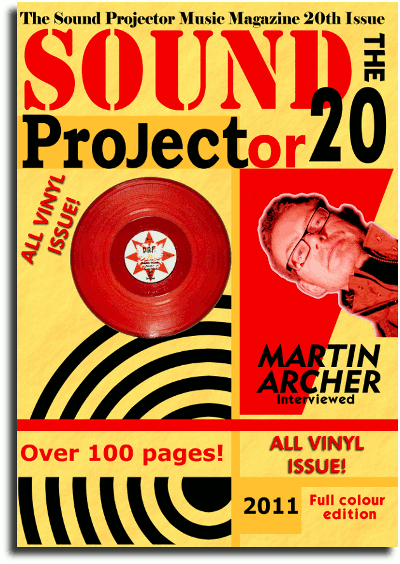
New issue of The Sound Projector out now!

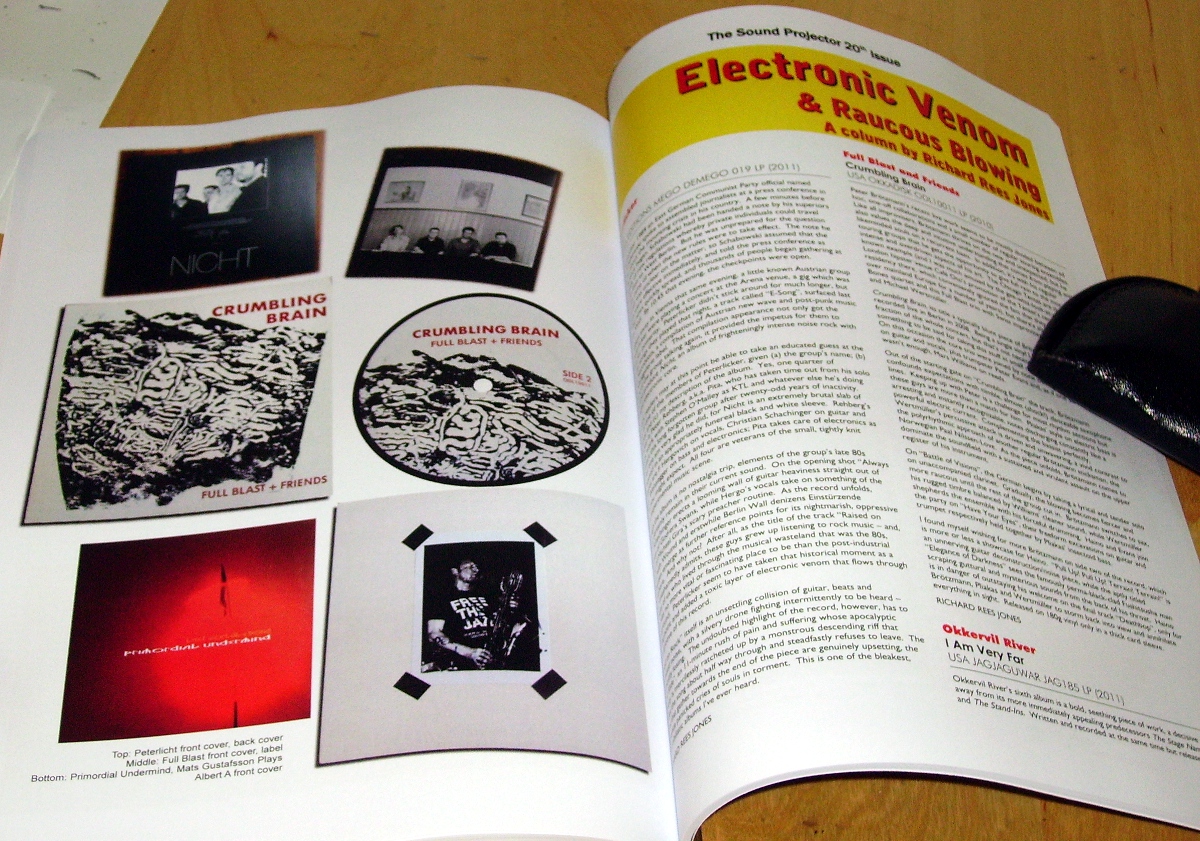
The new issue of Ed Pinsent’s wonderful music magazine The Sound Projector is out now. This is a special all-vinyl issue containing nothing but reviews of vinyl LPs and singles, along with many sumptuous photographs of album sleeves, coloured vinyl discs, labels and inserts. 128 exciting pages – and for the first time, the magazine is available in two versions, full colour and b&w!

I’ve contributed reviews and photos of the following albums to the magazine:

Richard Youngs – Inceptor, Atlas of Hearts
Primordial Undermind – Last Worldly Bond
Mats Gustafsson – Mats G Plays Albert A, Needs
Full Blast and Friends – Crumbling Brain
Okkervil River – I Am Very Far
Peterlicker – Nicht
The Thing – Bag It!
Zu – Carboniferous
Fire! – You Liked Me Five Minutes Ago, Unreleased?

You can read full details, including how to buy, here.


Unfolk/Kevin Hewick, The Venetian Book of the Dead

That title The Venetian Book of the Dead leads one to expect some kind of facile Goth travelogue.  It’s an impression not exactly dispelled by the cover, with its illustration of skeletons, shrouds and crucifixes.  Yet to dismiss the album on this basis would be a big mistake.  Yes, it’s about death, but it’s also a compelling album of contemporary protest songs, rooted firmly in modern history and driven by a sense of righteous outrage.

Continue reading

Chris Connelly, How This Ends

Fine album of dark ambient weirdness from a veteran of the British and American Industrial scenes. The Scottish-born Connelly has been a persistent presence among these networks for over twenty years, having served time with Ministry and Revolting Cocks as well as racking up a not inconsiderable twelve solo albums. What I find most impressive about this latest effort is its unusual form, evidence of a distinctive musical intelligence at work.

Continue reading

Roshi feat. Pars Radio, The Sky and the Caspian Sea

The Sky and the Caspian Sea is an enchanting collection of torch songs from a young Welsh-Iranian singer, Roshi Nasehi.  Roshi takes elements of Iranian folk song and blends them into her own, decisively modern take on the ballad.  Accompanying herself on piano and backed by a superb three-piece group, Roshi threads her way through these songs with swanlike grace and imparts a deeply moving sense of spiritual and cultural ‘otherness’.

Continue reading